Arietta Hallock

Journalist, Essayist, Food Editor

Author: Arietta Hallock

  • Finding authenticity within the algorithm

    How can young reporters build a personal brand within the disruptive noise of social media?

    Photo by Shefali Lincoln via Unsplash.

    “When I talk about journalism, I liken it to an earthquake. … The shaking has not stopped. We are actually still in the middle of the earthquake happening,” former CNN anchor Alisyn Camerota told the Poynter Institute recently.

    The ever-shifting age of social media has sent seismic shifts into the bedrock of journalism, and traditional outlets and reporters are scrambling to find stability within the noise. So too are consumers.

    Achieving authenticity online

    Camerota’s quote comes in the context of a Poynter piece for young journalists about building a brand on social media. In the age of the influencer, coming across as authentic as an aspiring journalist is becoming increasingly important. It can sometimes feel hard to keep up.

    This new need marks a shift in audience attitudes towards the content and news that they consume. In algorithms where grabbing attention is paramount, active audiences crave the “authenticity” of their favorite influencers, even from journalists. The normalcy of parasocial relationships has made it more difficult for journalists to keep their process private while still growing their audience across platforms.

    Sharing behind-the-scenes, human peeks at the reporting process is one way of responding to the creator economy. It can also help reporters regain credibility in the context of “fake news” content creators. It builds trust into the personal brand of a journalist.

    How a tweet can create trust

    Professor and journalist Anthony Adornato gives a few real life examples of this in his book, Mobile and Social Media Journalism. One is a 2016 tweet from New York Times investigative reporter David Fahrenthold, from a time before “branding” was such a buzzword.

    “I’ve now called 313 charities in my search for proof @realDonaldTrump gives his own money away. Not much luck lately,” Fahrenthold posted, alongside a picture of his pencilled-in reporter’s notebook.

    In the rapid-fire world of social media where context often collapses and misinformation rises to the top, it’s refreshing to see proof of research– even in the dead-end moments. Farenhold wasn’t strategically “building a brand”, but simply being himself.

    “The hope is that through authentic engagement the active audience recognizes the value of journalists, and that keeps them coming back for more— no matter the platform,” Adornato wrote.

    Branding as a tool

    While branding can feel performative or even antithetical for journalists who are used to putting the story first, Fahrenthold’s old post and Adornato’s words can offer some solace. Or at least an honest prediction of where we’re headed.

    Building a brand is not a test for young journalists, but a tool for authentically reaching audiences on the platforms they’re turning to.

    “At some point, the rattling and shaking will stop, and we’ll come out and assess the damage and see what is still standing, and then we’ll have to rebuild,” Camerota told Poynter, “But I don’t see journalism going away. I see the delivery systems changing.”

    While the ground is still shifting, building a brand on social media may be the solid foundation young journalists are searching for.

  • 'Does this matcha latte make me look performative?'

    How the beloved beverage landed at the center of a viral social media meme.

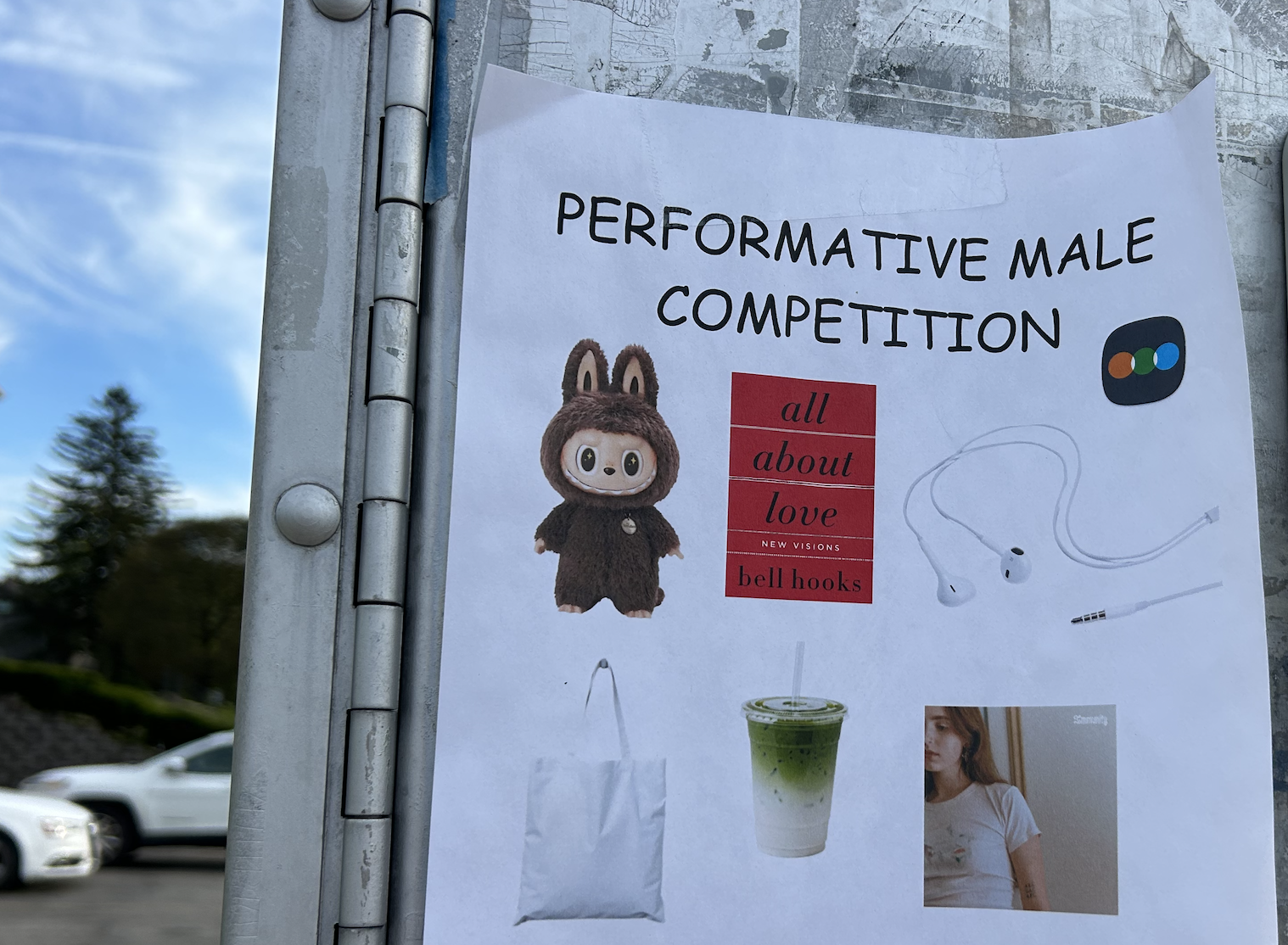
    Photo by Arietta Hallock

    Last week, a flyer taped to a pole on the edge of campus caught my eye.

    With the help of half-hazard PhotoShop, someone had scattered stock images of seemingly unrelated items across the white paper.

    The classic novel All About Love by Bell Hooks, the cover of Clairo’s 2019 album Immunity, and a deep green iced matcha latte dotted the page.

    I paused in my tracks. Visions of a bookstore-cafe with an excellent playlist and even better baristas danced through my head.

    Then I read the title typed in Comic Sans at the top, and my dreams were dispelled:

    PERFORMATIVE MALE COMPETITION.

    The making of a meme

    The performative male, like the “poser” of the ’90s, is a new cultural archetype that has reached meme status on social media. The term describes a particular kind of man who caters his aesthetic and style to the presumed tastes of feminist women.

    “He is, in short, the antithesis of the toxic man.” Alisha Haridasani Gupta and Nicole Stock of The New York Times recently wrote. “Such a man might sip on iced matcha lattes at a cafe while reading Sally Rooney or Joan Didion.”

    In the vein of recently trending celebrity lookalike contests, college campuses have begun to compete over who can best fit the newly defined caricature.

    That’s where the iced matcha, tote bags, and soft-pop playlists promoted on the poster come into play.

    As with any burgeoning internet lingo, the actual definition of what makes a performative male is still uncertain. The one clear marker, though? They love posing with iced matcha lattes.

    Matcha’s trending aesthetic

    How did matcha become a core pillar of the “performative male” aesthetic? Like many internet users trying to keep up with food trends, I’m not entirely sure.

    The TikTok-trending beverage has been popular among young women in recent years, with overpriced cups from Blank Street serving as an aesthetic accessory.

    Sweet and colorful, the drink has also transformed into a cultural marker of softness and style. It pairs well with the proposed aesthetic of the performative male archetype.

    When pop culture reframes food (and vice versa)

    The nature of the internet is that it is constantly renegotiating meaning. One meme can turn a food or drink into a TikTok icon, overlaying original cultural context in the eyes of young viewers. These negotiated meanings can just as quickly change again.

    Regardless of distaste for passing memes or performative males, a craving for matcha proved victorious at the campus competition. Swaths of students kicked back in tote bags and baggy jeans, sipping green lattes from plastic cups before the crowd.


  • The Art of Connection

    The Art of Connection

    Welcome to WordPress! This is a sample post. Edit or delete it to take the first step in your blogging journey. To add more content here, click the small plus icon at the top left corner. There, you will find an existing selection of WordPress blocks and patterns, something to suit your every need for content creation. And don’t forget to check out the List View: click the icon a few spots to the right of the plus icon and you’ll get a tidy, easy-to-view list of the blocks and patterns in your post.

  • Beyond the Obstacle

    Beyond the Obstacle

    Welcome to WordPress! This is a sample post. Edit or delete it to take the first step in your blogging journey. To add more content here, click the small plus icon at the top left corner. There, you will find an existing selection of WordPress blocks and patterns, something to suit your every need for content creation. And don’t forget to check out the List View: click the icon a few spots to the right of the plus icon and you’ll get a tidy, easy-to-view list of the blocks and patterns in your post.

  • Growth Unlocked

    Growth Unlocked

    Welcome to WordPress! This is a sample post. Edit or delete it to take the first step in your blogging journey. To add more content here, click the small plus icon at the top left corner. There, you will find an existing selection of WordPress blocks and patterns, something to suit your every need for content creation. And don’t forget to check out the List View: click the icon a few spots to the right of the plus icon and you’ll get a tidy, easy-to-view list of the blocks and patterns in your post.

  • Collaboration Magic

    Collaboration Magic

    Welcome to WordPress! This is a sample post. Edit or delete it to take the first step in your blogging journey. To add more content here, click the small plus icon at the top left corner. There, you will find an existing selection of WordPress blocks and patterns, something to suit your every need for content creation. And don’t forget to check out the List View: click the icon a few spots to the right of the plus icon and you’ll get a tidy, easy-to-view list of the blocks and patterns in your post.

  • Teamwork Triumphs

    Teamwork Triumphs

    Welcome to WordPress! This is a sample post. Edit or delete it to take the first step in your blogging journey. To add more content here, click the small plus icon at the top left corner. There, you will find an existing selection of WordPress blocks and patterns, something to suit your every need for content creation. And don’t forget to check out the List View: click the icon a few spots to the right of the plus icon and you’ll get a tidy, easy-to-view list of the blocks and patterns in your post.

  • Adaptive Advantage

    Adaptive Advantage

    Welcome to WordPress! This is a sample post. Edit or delete it to take the first step in your blogging journey. To add more content here, click the small plus icon at the top left corner. There, you will find an existing selection of WordPress blocks and patterns, something to suit your every need for content creation. And don’t forget to check out the List View: click the icon a few spots to the right of the plus icon and you’ll get a tidy, easy-to-view list of the blocks and patterns in your post.